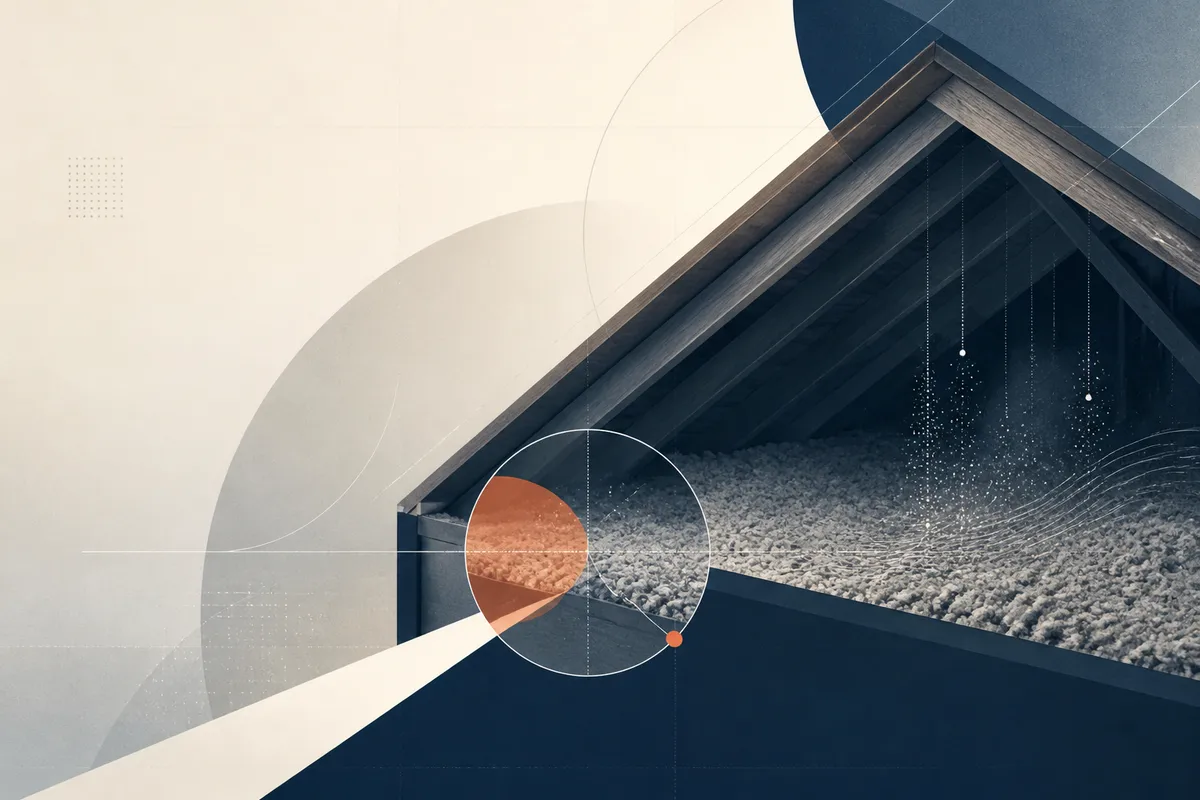
The Physics of Asbestos Settling in Attic Vermiculite
Most property owners in the region assume a handful of surface scoops from an attic are sufficient to rule out a health hazard. In reality, testing only the top two inches of vermiculite insulation is often insufficient. Because asbestos fibers can be finer than the puffed vermiculite pebbles, they may sift through the insulation over years of home vibration, potentially concentrating in a thin layer of dust directly on the drywall or wood lath.
This guide explains why vermiculite insulation sampling depth is a critical variable in any hazardous material inspection. For those planning to disturb an attic space, understanding these mechanics prevents the accidental release of fibers during HVAC installs or structural repairs.
Why Standard Surface Testing Fails
When vermiculite is poured into an attic, the material is a mix of lightweight mica-like flakes and microscopic mineral contaminants. Over forty or fifty years, everyday factors—such as heavy traffic on the street, slamming doors, or thermal expansion—act on the insulation.
- Large vermiculite pebbles stay at the surface while smaller asbestos fibers may gravitate downward.
- The fine dust at the bottom of the joist cavity often contains the highest concentration of contaminants.
- Airflow from soffit vents can shift lighter surface materials, leaving the denser hazardous particles trapped against the floor.
- Disturbance of any kind could potentially release asbestos fibers into the air, making the initial sampling accuracy vital for safety.
The Professional Playbook for Vermiculite Assessment
Accurate testing requires more than just a visual inspection. If you are renovating a home in the Matthews service area or surrounding suburbs, a standardized approach to sampling ensures no hidden layers are missed.
1Identify the Material Origin
Standard insulation is often gray and fibrous, but vermiculite looks like small, shiny pebbles, usually silver-gold or brownish-gray. A significant portion of this material sold under the brand name Zonolite contains tremolite or actinolite asbestos, which was naturally present in the Montana mine where the ore was extracted.
2Establish Full-Depth Access
A sampler must reach the very bottom of the insulation, where the material meets the ceiling of the room below. This involves clearing a small area of the top flakes to reach the "fines" or the dust layer sitting on the substrate. Failing to reach this depth is the primary reason for inaccurate "non-detected" results in contaminated homes.
3Capture Multiple Core Points
Attic insulation is rarely uniform in its composition across the entire floor. A standard protocol involves taking samples from multiple locations—near the eaves, in the center, and near the attic hatch—to account for how air movement and foot traffic might have redistributed the fibers.
4Minimize Dust During Entry
Even a simple inspection can be hazardous if the material is stirred up carelessly. The Asbestos Testing & Inspection process should always be performed by a professional using a "wet method" or specialized tools to ensure that neither the inspector nor the occupants are exposed to airborne particles during the sampling.
The Mechanics of Amphibole Fiber Migration
Amphibole asbestos fibers, like those found in Libby vermiculite, have a needle-like structure. Unlike the curly chrysotile fibers often found in pipe wrap, these needles can work their way through the loose, granular structure of vermiculite pebbles. Every time a heavy truck drives by or a thunderstorm vibrates the house, the pebbles shift slightly, allowing the smaller needles to fall into the gaps.
This creates a stratified environment. The concentration of asbestos can vary significantly between the top layer and the bottom layer of dust against the floorboards. For a renovation crew, disturbing any part of the insulation without proper containment is dangerous. Professionals refer to the Mecklenburg County Code Enforcement resources for guidance on structural permits, but the environmental safety of the attic is a specialized prerequisite.
How Charlotte Asbestos Removal helps
When managing a property with suspected contamination, the standard scope of work begins with a comprehensive site assessment to determine the volume of material present. A qualified crew will typically establish a negative pressure environment and use HEPA-filtered vacuums specifically designed for vermiculite removal to clear the joist cavities entirely. This process ensures that the fine dust at the bottom is not left behind to contaminate the home during future electrical or plumbing work. Property owners can start the process by visiting https://charlotteasbestosremoval.com/ for a detailed consultation.
Frequently asked questions
Does all vermiculite insulation contain asbestos?
Not all vermiculite is contaminated, but a vast majority of the product installed in the U.S. between 1920 and 1990 came from a contaminated source. Because it is impossible to tell by looking at the pebbles, the EPA recommends assuming the material contains asbestos or having it tested by a professional.
Why did my first test come back negative if the house was built in 1950?
False negatives are common when the inspector only scoops from the top layer of the insulation. If the vermiculite insulation sampling depth did not reach the ceiling joists, the lab likely only analyzed the cleaner pebbles and missed the concentrated asbestos dust at the bottom.
Can I just cover the vermiculite with new fiberglass batts?
Adding new insulation over the top does not remove the hazard and can actually make future repairs more dangerous. Adding more weight on top of the material can lead to further disturbance, and any future worker who has to move the new batts will unknowingly stir up the older, contaminated material.
Is it safe to store boxes in an attic with vermiculite?
The EPA advises against using attics with vermiculite for storage because moving items can stir up the dust. If you must enter the attic, you should limit your time there, wear a respirator, and avoid any activity that creates visible dust until the material is professionally mitigated.
How long does a typical removal take?
Timelines vary based on the square footage of the attic, the thickness of the insulation, and the accessibility of the joist cavities. The process includes the setup of containment barriers, the physical removal of the material using specialized vacuum equipment, and the final HEPA cleaning of the substrate. Residents in Mecklenburg County should call (704) 327-3475 to discuss specific scheduling for their property.
What happens when you get in touch: you describe the situation, we ask the few questions that actually change the answer, and you get a clear scope and next step — no obligation.