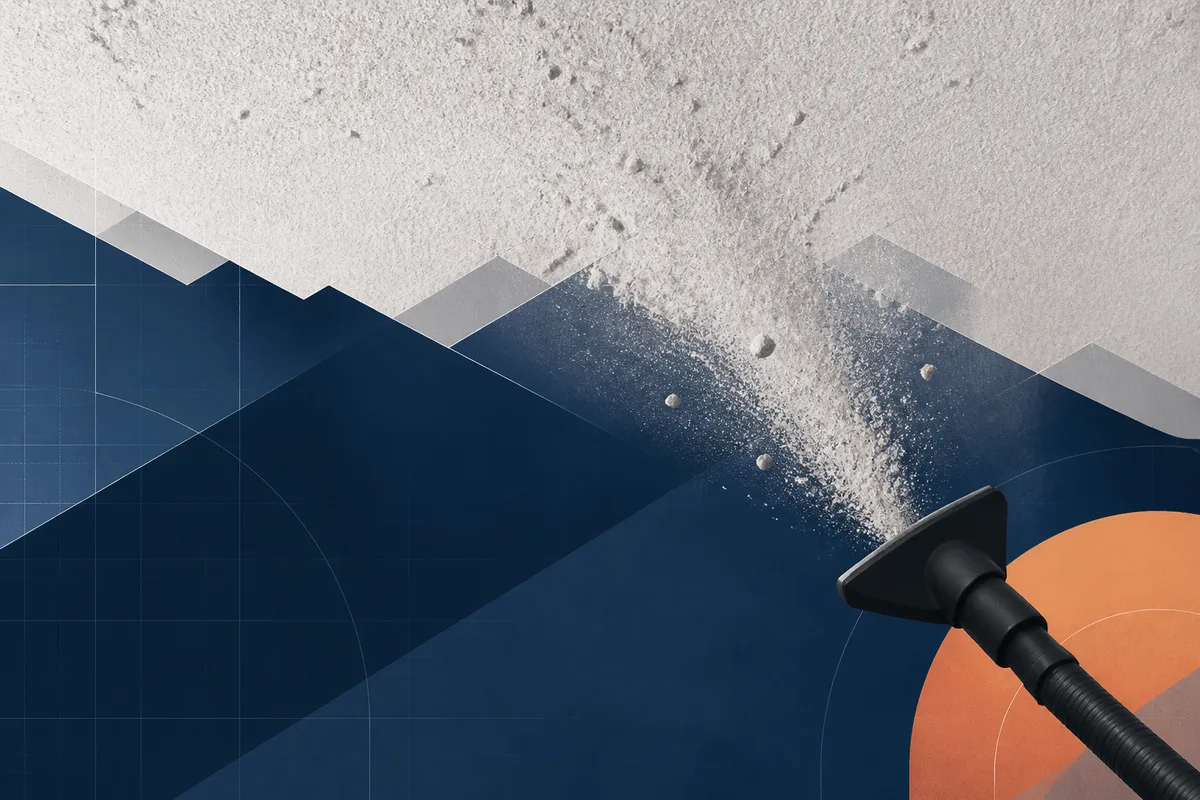
The Aerosolization Trap: Why Standard Vacuums Fail on Textured Ceilings
Using a standard shop vacuum to clean up debris from a textured ceiling is a common mistake that turns a localized mess into a building-wide contamination event. While these machines have high suction, their filtration systems are designed for visible debris; microscopic fibers simply pass through the filter pores and are blasted out of the exhaust at high velocity. In a residential or commercial setting, this effectively aerosolizes a hazard that was previously heavy and contained, making it nearly impossible to settle without professional air scrubbing.
This guide breaks down the technical failure of non-HEPA filtration when handling potentially hazardous mineral fibers. For property owners in the Charlotte area, understanding the micron-scale mechanics of ceiling dust is the difference between a successful renovation and a long-term liability.
Why Standard Filtration Fails on Mineral Fibers
Standard vacuum filters are engineered to handle "nuisance dust" like wood shavings or drywall mud, but they cannot provide adequate asbestos dust filtration risks management. Standard vacuums are not designed to handle the fine, abrasive particles of construction dust, which often leads to clogged filters and reduced performance sanitmax.com.
- Standard pleated filters have pore sizes significantly larger than a single mineral fiber, allowing the smallest, most dangerous particles to pass through.
- High-airflow exhaust ports act as distribution hubs, scattering fine particulates into the HVAC system and onto soft surfaces like carpets and upholstery.
- The agitation caused by vacuuming dry texture often creates a higher concentration of airborne mineral fiber safety issues than the original debris.
- Vacuum canisters are rarely airtight, allowing "leakage" of fine dust around the motor housing before it ever reaches the filter.
The Technical Requirements for Ceiling Debris Containment
Managing textured ceiling dust requires a shift from "cleaning" to "abatement-level containment." If the material is disturbed during renovation, the North Carolina State Construction Office provides guideline criteria for how these materials must be handled in state-owned buildings, a standard that should be mirrored in private properties.
1Establish the Micron Threshold
A true HEPA (High-Efficiency Particulate Air) vacuum is not just a brand name; it is a performance standard. Recommended units for asbestos cleaning include Type-H or class-H vacuums with certified filters, such as Nilfisk, Pullman, or Euroclean models facebook.com. Standard shop vacs often claim "fine dust" capabilities, but they lack the multi-stage sealing required to prevent bypass.
2Implement Wet-Method Handling
Fibers cannot become airborne if they are saturated. Before any vacuuming or scraping occurs, the texture is typically misted with amended water. This increases the mass of the particles, making them more likely to stay trapped in a specialized filtration medium rather than floating in the air.
3Verify Sealed Housing and Connections
A vacuum is only as good as its weakest seal. Professional-grade units used for cleaning up ceiling texture dust feature locking hoses and O-ring gaskets. This ensures that every cubic inch of air pulled in through the nozzle is forced through the HEPA filter before exiting the machine.
4Direct Air Monitoring and Clearance
In any project involving potential mineral fiber release, the vacuuming phase is just one part of the process. Following the removal, air clearance testing should be performed by a third party to ensure the room is safe for occupancy. This is particularly critical in the humid Charlotte climate, where stagnant air can hold fine particulates in suspension for extended periods.
The Physics of HEPA vs. Shop Vacuums
The primary difference lies in the mechanism of "interception." A shop vac relies on a simple sieve effect—if the particle is smaller than the hole in the paper, it goes through. HEPA filters utilize three distinct methods: diffusion, interception, and impaction. Because mineral fibers are so light, they move erratically (Brownian motion), which causes them to collide with and stick to the dense maze of fiberglass fibers inside a HEPA filter.
When you use a shop vac, you are not just failing to catch the dust; you are concentrating it. The vacuum sucks up dust from the floor and sprays a concentrated mist of sub-micron fibers into your breathing zone at chest level. This is why asbestos in the home is often a greater risk after a botched DIY cleanup than when it was sitting undisturbed on the ceiling.
Professional Remediation Standards
When a property owner in the Charlotte area identifies a need for ceiling work, a sound scope of work begins with an Asbestos Testing & Inspection. This determines the concentration of mineral fibers and informs the level of containment required. A typical project involves isolating the work area with 6-mil poly sheeting, establishing a negative pressure environment, and using HEPA-filtered extraction.
For those in areas like Matthews, it is essential to ensure that any contractor hired can provide documentation of their filtration testing. Owners should expect a detailed plan that covers the containment and disposal of all debris generated during the process. If you suspect your ceiling contains hazardous materials, call (704) 327-3475 to discuss proper testing and removal protocols.
Frequently asked questions
Can I just put a HEPA filter in my regular shop vac?
No, because standard vacuums are not airtight. Even with a high-efficiency bag or filter, the motor housing and hose connections often leak air. This allows microscopic fibers to bypass the filter entirely and escape through the gaps in the vacuum's plastic casing.
How do I know if my textured ceiling contains mineral fibers?
You can’t see them, smell them, or detect them without lab testing bannerenvironmental.com. You should have a professional collect a physical sample under controlled conditions to avoid releasing fibers during the sampling process itself.
What are the specific health risks of inhaling ceiling dust?
Inhaling these fibers can lead to asbestosis, which is a permanent scarring of the lung tissue, as well as lung cancer and mesothelioma. According to research published by the NIH, the probability of developing lung disease is significantly higher for individuals who lived with these types of ceilings when they became damaged or were improperly removed.
Is it safe to scrape a popcorn ceiling if I wear a N95 mask?
An N95 mask is generally insufficient for asbestos-grade fibers, as it does not provide a high enough protection factor or a guaranteed seal. Furthermore, the mask only protects the wearer, leaving the rest of the home or building contaminated with dust that will settle on surfaces and be re-disturbed later.
Are there specific regulations for asbestos in North Carolina?
Property owners should consult the North Carolina Health and Human Services guidelines to ensure they are compliant with state requirements regarding occupant exposure and building contamination. State-owned buildings must follow specific guideline criteria for asbestos control during disturbances.
What should I do if I already vacuumed ceiling dust with a regular vacuum?
Immediately turn off your HVAC system to prevent the dust from spreading through the ductwork. Seal the vacuum in a heavy-duty trash bag and contact a professional remediation firm to perform air testing and a specialized "wet-wipe" cleaning of the affected rooms.
What happens when you get in touch: you describe the situation, we ask the few questions that actually change the answer, and you get a clear scope and next step — no obligation.